Foundation Skills for Agility: Why Handling Comes Before Equipment
Wondering why your agility dog has plateaued? Discover why flatwork and handling skills matter more than equipment time, and how Foundation Skills for Agility builds the basics properly.
If you have spent any time around agility, you will have seen it. A dog that flies over a single jump beautifully, then falls apart the moment two obstacles get linked together. It is not bad luck, and it is not a bad dog. It almost always comes down to one thing: the handling and flatwork underneath it all was never properly built.
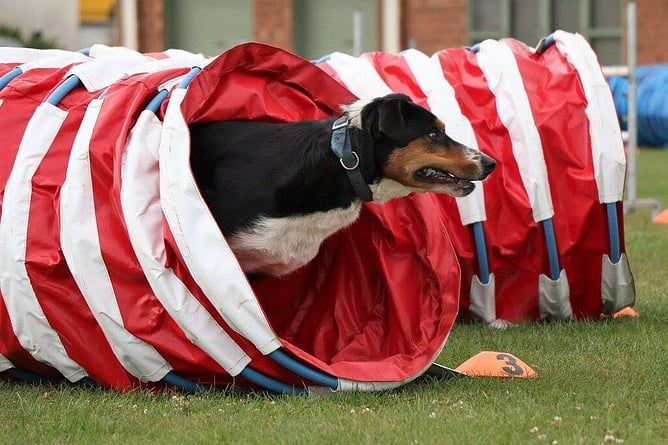
Most dogs pick up the physical side of agility fast. Jumping, running through a tunnel, even weaving with enough repetition, these come quickly because they are fun and physical and dogs love them. The part that takes longer, and the part that actually makes the difference between a frustrating run and a flowing one, is everything that happens between the obstacles.
What flatwork actually builds
Flatwork is all the work we do away from equipment, body position, timing, directional cues, your dog reading your shoulders before you have said a word. It sounds unglamorous next to a full course run, but it is the part that decides whether your dog understands where to go next or is simply guessing and hoping.
A dog with solid flatwork foundations does not need to be physically herded around a course. They read you. They commit to a line because they trust the information you are giving them, not because they are following a string of obstacles one at a time.
Why this matters if you have already started
This is especially true for handlers who have dabbled in agility already. If your dog knows the equipment but your runs still feel scrappy, more equipment time will not fix it. Going back to flatwork, even briefly, almost always unlocks more progress than another month of jumps and tunnels.
I see this constantly. A team plateaus, equipment confidence is high, but something in the handling, a late shoulder turn, an unclear cue, a mistimed cross, keeps causing the same mistake. Once that gets fixed at the flatwork level, the whole course starts to flow.
Building it properly, from the start
This is exactly why Foundation Skills for Agility leads with flatwork and handling before equipment ever comes into it. Dogs who build this way are calmer on course, more confident in their decision making, and a lot more fun to run, because the partnership is built on understanding rather than just repetition.
If your dog has hit a wall, or you are just starting out and want to do it right from day one, this is where it begins.
Beverley
Lifestylesolutions CHB