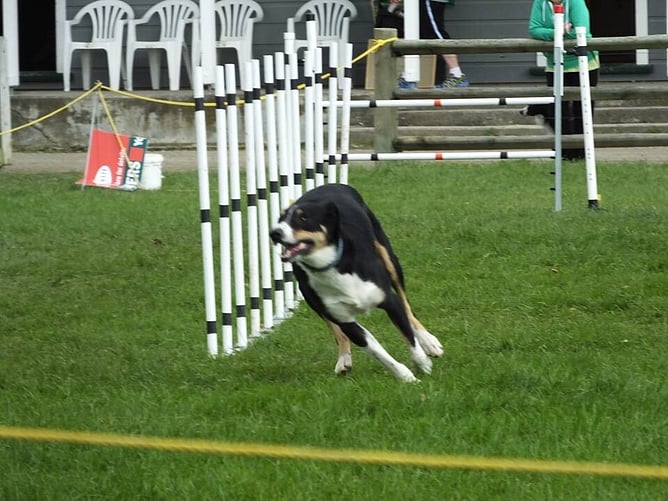
Over arousal in high energy dogs
The bucket is full and there is no more band width: Understanding and Managing Over-Arousal in Sports and High Energy Dogs
Your dog isn't being naughty. They've run out of bandwidth. Here's what's actually happening — and what to do about it.
You've done the training. Your dog knows the course, the obstacles, the cues. And then you get to the trial, or the ring, or even just a high-excitement training session — and a completely different animal shows up.
They blast past obstacles. They bark at nothing. They spin or zoom or freeze. They look straight through you like you're made of glass. And the harder you try to get their attention, the worse it gets.
This is over-arousal. And it is one of the most misunderstood things in dog sports. It gets called naughtiness, stubbornness, dominance, lack of drive control. It's usually none of those things. It's a nervous system that has hit its limit — a bucket that is simply full
The Bucket: Why Your Dog Has a Stress Capacity
The bucket model is one of the most useful ways to understand how stress and arousal accumulate in dogs. Imagine your dog carries an invisible bucket with them everywhere. Throughout the day, things get tipped into it: excitement, frustration, physical exertion, new environments, unfamiliar dogs, a loud noise, a change in routine, lack of sleep, not enough food before a run. All of it goes in.
When the bucket gets too full, it overflows — and that overflow looks like over-arousal, reactivity, shutdown, or disconnection. The dog isn't choosing any of this. Their system has simply exceeded its capacity to regulate.
Here's the part people miss: the bucket doesn't empty between runs. Or even between days, necessarily. A dog who had a big exciting drive to the trial, has been crated in a busy environment for two hours, had a stressful first run, and is now waiting for their second — that bucket is already close to overflowing before they even hit the start line.
What fills the bucket
Excitement and anticipation (yes, good things fill it too)
Loud or chaotic environments
New or unfamiliar places
Other dogs, especially working or reactive dogs nearby
Physical effort without sufficient recovery
Handler stress and anxiety (dogs feel this acutely)
Heat, hunger, disrupted sleep routine
Unresolved arousal from earlier in the day or weekend
Pain or physical discomfort — always rule this out first
What empties the bucket
Sleep and genuine rest (not crated near a busy ring)
Calm, positive social contact with safe people and dogs
Sniffing and nose work — the most effective bucket-emptier there is
Predictable routines and familiar environments
Pattern games (more on these shortly)
Physical settling — slow massage, calm TTouch-style contact
Time — proper recovery time between high-arousal events
What's Actually Happening in the Brain
This is where it gets interesting — and where understanding the neuroscience actually helps you train better.
The dog brain (like the human brain) operates through two broad systems when it comes to stress and arousal. Simplified: there's the thinking brain and the survival brain.
The prefrontal cortex — your dog's thinking brain
This is where learning lives. Where cue-response happens. Where your dog processes what you're asking, weighs up their options, and makes a deliberate choice. When this part of the brain is online, your dog can hear 'sit' and think, right, she said sit, I know that, there's a reward coming, I'll do that.
The amygdala — the smoke detector
The amygdala's job is to scan for threat and trigger a survival response. It operates much faster than conscious thought. It's what makes you jump before you've consciously registered the noise. In dogs, the amygdala is highly sensitive and — in high-drive sports dogs especially — can be exquisitely tuned to respond to the cues that predict high-arousal events: the car ride to training, the tug toy coming out, the competition environment.
When the amygdala fires, it doesn't politely wait for the thinking brain to catch up. It hijacks the whole system. What neuroscientists call 'amygdala hijack' is exactly what's happening when your dog goes over threshold. The thinking brain goes offline. The survival/impulse brain takes over. And no amount of repeating your cue is going to bring the thinking brain back until the nervous system has had time to regulate.
The stress hormone cascade
When the amygdala fires, it triggers a release of cortisol and adrenaline. These are brilliant chemicals for an emergency — they sharpen the senses, flood the muscles with blood, and prepare the body for action. They are terrible chemicals for agility. Cortisol in particular suppresses the prefrontal cortex directly. Your dog's thinking brain is being chemically switched off.
The other important thing about cortisol: it takes time to clear. The half-life of cortisol in the body is around 40 minutes. Which means the effects of a stressful or highly arousing event can linger for an hour or more — long enough to affect the next run, and the run after that.
The bandwidth problem
Think of your dog's ability to process information as a bandwidth — like a broadband connection. In a calm state, they've got plenty of bandwidth: processing your body language, tracking the course, managing their own excitement, listening for cues. As arousal rises, bandwidth shrinks. By the time they're over threshold, almost all of it is being used just to manage the arousal itself. There's nothing left for course work. This isn't stubbornness — it's a full system.